How to Refinance Your Auto Loan and Save Thousands


Right now, approximately 900,000 borrowers with credit scores between 720 and 759 are paying 9–11% APR on their auto loans — rates they could reduce by refinancing. According to Equifax’s 2025 Market Pulse data, 60% of borrowers with a VantageScore above 680 and high APRs are ready to refinance and are twice as likely to take action. If you’re one of them, the question isn’t whether refinancing saves money — it almost certainly does. The question is how much, and whether the timing is right.
This comprehensive guide explains exactly how the refinance auto loan calculator process works, when it makes financial sense, where to find the best refinance rates, and how to execute the refinance from application to final approval.
What Is Auto Loan Refinancing?
Refinancing your car loan means taking out a new loan to pay off your existing one. Your new lender pays your old lender directly, and you begin making payments to the new lender at the new (hopefully lower) rate. The vehicle remains yours throughout the process — refinancing doesn’t affect your title or registration.
You can refinance to achieve three different goals:
Lower your interest rate — The most common reason. If your credit score has improved since your original loan or market rates have fallen, refinancing to a lower APR reduces your total interest cost.
Lower your monthly payment — By extending your loan term during refinancing, you spread payments over more months, reducing your monthly obligation. Important caveat: this increases your total interest paid.
Shorten your loan term — By refinancing to a shorter term (with potentially the same or lower rate), you pay off the loan faster and reduce total interest — though your monthly payment increases.
How Much Can You Actually Save? — Real Examples
Scenario 1: Rate Improvement (Credit Score Increased)
Original loan (taken when credit was 620):
- Remaining balance: $22,000
- Current APR: 14.5%
- Remaining term: 42 months
- Current monthly payment: $637
- Remaining interest if paid as-is: $4,754
Refinance offer (credit score now 720):
- New APR: 7.0%
- New term: 42 months
- New monthly payment: $558
- Total interest on refinanced loan: $1,436
Result:
- Monthly savings: $79/month
- Total interest savings: $3,318
- 42-month total savings: $3,318
For 15 minutes of paperwork, that’s an extraordinary return.
Scenario 2: Market Rate Drop
Original loan (taken in 2023 at peak rates):
- Remaining balance: $18,500
- Current APR: 9.8%
- Remaining term: 38 months
- Monthly payment: $558
- Remaining interest: $2,704
Refinance offer (rates fallen in 2025):
- New APR: 6.5%
- New term: 38 months
- New monthly payment: $530
- Total interest on refinanced loan: $1,640
Result:
- Monthly savings: $28/month
- Total interest savings: $1,064
Modest but real — over $1,000 saved with minimal effort.
Scenario 3: Term Extension to Lower Payment
Original loan:
- Remaining balance: $20,000
- Current APR: 7.5%
- Remaining term: 48 months
- Current monthly payment: $484
Refinance: extend to 60 months at same rate:
- New monthly payment: $401
- Total new interest: $4,060 vs $3,232 original remaining interest
Result:
- Monthly savings: $83/month
- Extra interest paid: $828
This scenario trades higher long-term cost for short-term cash flow relief. It’s a legitimate strategy if you need to free up monthly budget, but understand you’re paying for that convenience with extra interest.
When Does Refinancing Make Financial Sense?
Use a refinance auto loan calculator to confirm the numbers before applying, but refinancing generally makes sense when:
Your Credit Score Has Improved
The most impactful reason to refinance. If your score has risen 50+ points since your original loan, you likely qualify for a meaningfully lower APR. Even a 3–4 point improvement in rate on a $20,000 balance saves $1,000–$2,000 in total interest.
Market Rates Have Fallen
After the Federal Reserve began cutting rates in September 2024 (three consecutive cuts through December), many borrowers who took loans in 2022–2023 at peak rates can now refinance at meaningfully lower APRs. If your rate is above 9% on a new car or above 12% on a used car, check current offerings.
You Have Dealer-Financed Loan with Markup
Dealers legally mark up the wholesale rate they receive from lenders by 1–3% as profit (called “dealer reserve”). If you accepted dealer financing without comparing outside offers, you’re likely paying 1–2% more than necessary. Refinancing at your bank or credit union rate recovers that spread immediately.
You’re Still in the First Half of Your Loan
Refinancing is most valuable early in your loan because you have the most interest-bearing balance remaining. If you’re in the final 12–18 months of a 60-month loan, most of your interest is already paid and refinancing generates minimal savings.
You’ve Found a Significantly Lower Rate
“Significantly” means at least 1.5–2 percentage points lower. Small differences (0.25–0.5%) may not justify the minor credit impact and administrative effort of refinancing.
When Refinancing Doesn’t Make Sense
You Have a Prepayment Penalty
Some lenders (particularly in subprime auto lending) include prepayment penalties — fees for paying off your loan early. Check your current loan agreement. If a penalty exists, calculate whether the interest savings exceed the penalty cost.
You’re More Than Halfway Through Your Loan
By the midpoint of any amortizing loan, most of the interest has already been paid. Refinancing the remaining balance generates minimal savings even at a lower rate.
The New Loan Has High Fees
Some refinance lenders charge origination fees or title transfer fees. On a small remaining balance, these fees may offset the interest savings entirely.
Your Credit Score Has Decreased
If your credit has worsened since your original loan, refinancing will likely result in a higher rate offer, not lower. There’s no value in refinancing into a worse rate.
Your Vehicle Is Old or Has High Mileage
Most lenders won’t refinance vehicles over 7–10 years old or with more than 100,000–125,000 miles. Check eligibility criteria before applying.
Step-by-Step: How to Refinance Your Auto Loan
Step 1: Know Your Current Loan Details
Before applying anywhere, pull your current loan statement and record:
- Current interest rate (APR)
- Current remaining balance (your auto loan balance)
- Remaining term in months
- Payoff amount (slightly higher than balance — includes accrued interest)
- Any prepayment penalty language
Step 2: Check Your Credit Score
Pull your free credit report at AnnualCreditReport.com. Your FICO score determines what rates you’ll be offered. If your score is below 650, consider whether 60–90 days of credit building before applying could get you a materially better rate.
Step 3: Get Your Vehicle Information
Lenders need the vehicle’s:
- Make, model, year, and trim level
- VIN (Vehicle Identification Number)
- Current mileage
- Current estimated value (use Kelley Blue Book or Edmunds)
Lenders typically won’t refinance if the vehicle’s value is significantly lower than the outstanding balance (high LTV).
Step 4: Shop for Refinance Rates
Apply to 3–5 lenders within a 14–45 day window. All applications in this window count as a single hard inquiry for FICO scoring purposes, so there’s no penalty for shopping around. Apply to:
- Your current bank or credit union
- A competing credit union
- 1–2 online lenders (LightStream, Capital One Auto Finance, etc.)
Step 5: Compare Offers Using a Refinance Auto Loan Calculator
Don’t just compare monthly payments — compare total interest paid over the new term. Use the car loan comparison calculator to enter your current payoff amount and remaining months (Loan A) vs. each refinance offer (Loan B). The tool shows you exactly how much each option costs in total.
Step 6: Calculate Your Break-Even Point
If the refinance has any fees, calculate how many months it takes to recover them through monthly savings:
Break-Even Months = Total Fees ÷ Monthly Payment Savings

Example: $300 in fees ÷ $65/month savings = 4.6 months to break even
If you plan to keep the loan longer than the break-even point, refinancing is profitable.
Step 7: Apply and Complete the Refinance
Once you’ve chosen the best offer:
- Submit the formal application (the lender will pull your credit — this is the hard inquiry)
- Provide required documentation: proof of income, insurance, vehicle info, current loan statement
- Review the new loan agreement carefully — confirm the rate, term, total amount financed, and any fees
- Sign documents — the new lender pays off your old loan directly
- Confirm the old loan shows as “paid in full” on your credit report within 30–60 days
- Begin making payments to the new lender
Where to Find the Best Auto Refinance Rates in 2025
Credit Unions
Still the top option. Most credit unions have simple online refinance applications and fast approvals. Rates typically run 0.5–2% below commercial banks.
Capital One Auto Finance
One of the largest and most accessible online auto refinance lenders. Pre-qualification available with no credit impact. Good for borrowers with 620+ scores.
LightStream (division of Truist Bank)
Best for borrowers with excellent credit (720+). Offers some of the lowest auto refinance rates available, no fees, and same-day funding in many cases.
Bank of America
Competitive rates for existing customers. Worth checking as part of your comparison if you already bank there.
RefiJet / RateGenius / AutoPay
These are refinance-focused marketplaces that submit your application to multiple lenders simultaneously. Useful if you want to minimize the number of individual applications you manage.
Effect of Refinancing on Your Credit Score
Refinancing has a minor, temporary effect on your credit:
Hard inquiry: Each lender you apply to performs a hard credit pull, which reduces your score by 2–5 points. Multiple inquiries within 14–45 days count as one inquiry for auto loan purposes under FICO scoring.
Account opening: Your new loan appears as a new account, slightly reducing your average account age — a minor negative.
Account closure: Your old loan is paid off and closed, which can affect your credit mix slightly.
Net impact: Most borrowers see a temporary dip of 5–15 points, fully recovering within 3–6 months of on-time payments on the new loan. The long-term credit effect of successfully managing a refinanced loan is positive.
Refinancing Calculator — Quick Reference
Use this table to estimate your savings before using the full calculator:
Monthly Payment Reduction by Rate Decrease (Per $10,000 Balance, 36 Months Remaining):
| Rate Reduction | Monthly Savings | Total Savings |
|---|---|---|
| 1.0% lower | ~$5/month | ~$180 |
| 2.0% lower | ~$9/month | ~$324 |
| 3.0% lower | ~$14/month | ~$504 |
| 4.0% lower | ~$18/month | ~$648 |
| 5.0% lower | ~$23/month | ~$828 |
For larger balances and longer remaining terms, multiply proportionally. A $25,000 balance with 48 months remaining and a 4% rate reduction saves approximately $1,620 in total interest.
After Refinancing — Maximize Your Savings
Set up autopay. Many lenders offer a 0.25% APR discount for autopay enrollment. On a $20,000 balance, that saves approximately $150 in total interest.
Keep making your old payment amount. If your refinance reduced your monthly payment by $70, keep paying the old amount. That extra $70/month goes directly to principal, accelerating your auto loan payoff and saving additional interest.
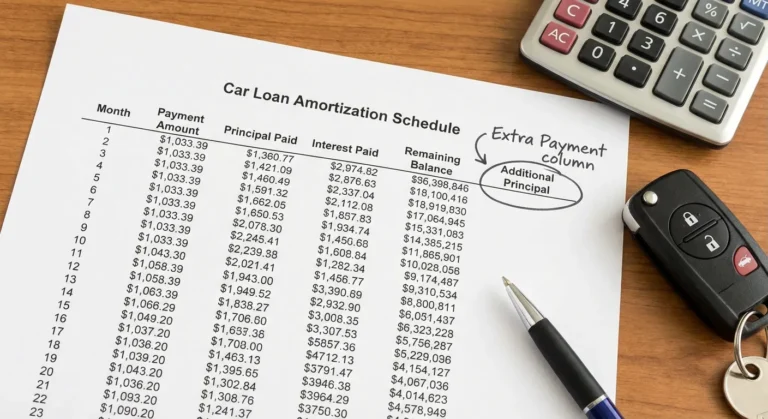
Track your payoff date. Use the amortization schedule feature of an auto loan calculator to see exactly when you’ll own the vehicle free and clear under your new terms.
Key Takeaways
- Up to 900,000 borrowers with 720+ scores are currently overpaying on auto loans they could refinance
- The best time to refinance is when your credit has improved 50+ points since origination
- Rate shopping across 3–5 lenders within 45 days counts as one hard inquiry
- Use a refinance auto loan calculator to compare total cost, not just monthly payment
- Breaking even on any refinance fees typically takes 3–6 months — well worth it on remaining balances above $10,000
- Credit unions and LightStream consistently offer the best refinance rates
- After refinancing, continue paying your previous payment amount for maximum payoff acceleration
Use our free Auto Loan Refinance Calculator to see exactly how much you’d save by refinancing today.